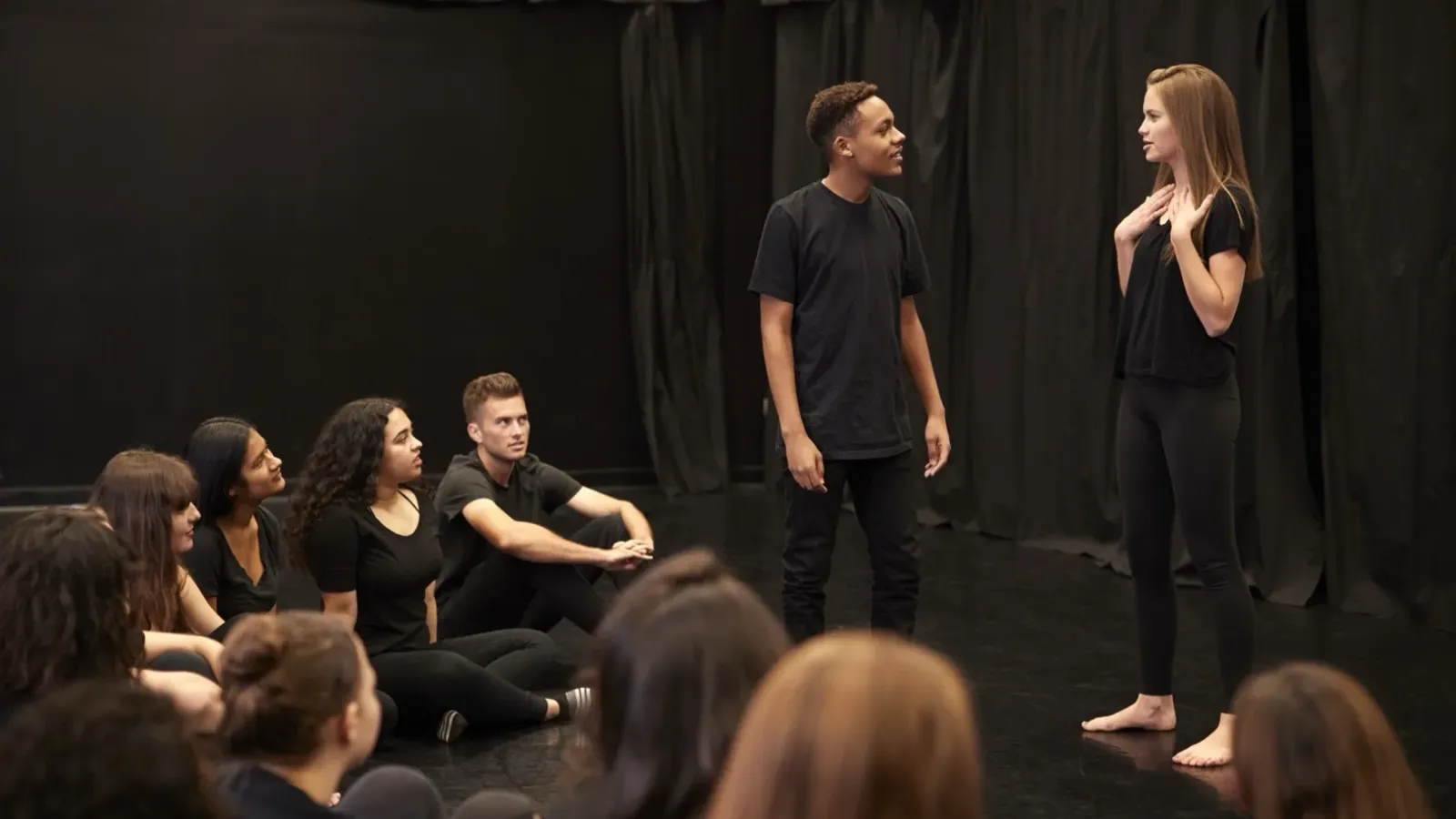
The argument about AI in acting training usually gets framed as a cage match: will the algorithm replace the coach, or is it all hype that can't touch real craft? Both framings are wrong. The honest answer is that AI feedback and human coaching are good at almost entirely different things — and an actor who understands the division of labour gets more out of each. This is a case for the hybrid model, made without pretending AI is more than it is.
What AI feedback genuinely does well
Start with the parts that are real, because they're easy to dismiss and shouldn't be.
Consistency. A human coach is brilliant but variable — tired on Friday, generous after a good rehearsal, harder on you the week they're stressed. An automated assessment applies the same rubric to every take, yours and everyone else's. That uniformity is exactly what you want when you're trying to measure whether you changed between Tuesday and Thursday. It's also one of the documented strengths of AI in a coaching context: delivering uniform quality without the day-to-day variability of a person (what AI coaching can and can't do).
24/7 availability. Inspiration and panic don't keep office hours. The night before a self-tape deadline, no coach is awake to give you a read — but an instant score across tone, expression, body language, and emotional delivery is. On-demand, no scheduling, judgment-free practice is precisely where AI tools earn their keep.
Objective dimension scoring. Breaking a performance into named dimensions and scoring each one turns a fuzzy "that didn't quite work" into "your vocal choices were specific but your physical ones read as generic." That specificity is what the feedback research says actually drives learning. Valerie Shute's review Focus on Formative Feedback found feedback is most useful when it's specific and tied to the task — and consistent dimension scoring is a reliable way to deliver that at scale.
Removing "who you can afford" as the gatekeeper. This is the one that matters most for fairness. Historically, the quality of feedback an actor receives has tracked their bank balance and their network — who they trained with, who'll take their call. Cheap, repeatable, baseline feedback decouples early progress from privilege. It won't make you a star, but it means a talented actor in a town with no studio isn't flying completely blind. That's a real democratisation of the first rung, even if the higher rungs still need people.
It's worth being precise about why these strengths are real rather than marketing. They all share one property: they're about measuring execution at volume. A rubric doesn't get bored on the fortieth take, doesn't have a favourite student, and doesn't charge by the hour. Anywhere the bottleneck in your training is "I need many honest, comparable reads, cheaply and often," AI is genuinely the better tool — and pretending otherwise out of loyalty to tradition just slows actors down.
What only a human coach can provide
Now the honest other half. Everything above is about execution and measurement. None of it is the same as artistry, and the research on AI's limits is consistent about why.
- Taste and interpretation. A score can tell you a beat read as flat. It cannot tell you the braver, weirder, more specific choice that would make the scene unforgettable — because that's a judgment about meaning, not execution. AI systems excel at pattern-matching against what's typical; a coach helps you find what's true and surprising, which is often the opposite of typical.
- Context. A coach knows this is a Mike Leigh-style improv audition versus a four-camera sitcom, that the director hates over-rehearsed reads, that your tendency is to push when you're nervous. AI assesses the take in front of it; a human reads the situation around it.
- Tacit knowledge. Much of acting craft is the kind of knowing that can't be fully written down — it's transmitted by working beside someone who has it. Research on AI coaching warns that these tools tend to privilege explicit, decontextualised knowledge and struggle with the situated, embodied judgement at the heart of real mastery (can AI chatbots provide genuine coaching).
- Emotional safety and live direction. Acting asks you to be vulnerable on demand. A trusted coach builds the relationship that makes risk feel safe, and can redirect you in the moment — "again, but this time you actually want to leave." The AI coaching literature is clear that trust, accountability, and contextual judgement are not future limitations to be patched, but fundamental to what makes coaching work.
Why the hybrid model wins
Put the two columns next to each other and the design almost writes itself. AI handles the high-frequency, low-stakes, measurable layer; humans handle the high-stakes, interpretive, relational layer.
This isn't a compromise — it's how skill is supposed to be built. The foundational work on expertise by K. Anders Ericsson describes deliberate practice as focused repetition with immediate feedback, guided by a teacher who can see what you can't (Ericsson on deliberate practice). Notice it needs both: the tight feedback loop and the expert eye. And feedback theory backs the split — Hattie and Timperley's The Power of Feedback found that feedback at the level of task and strategy (where AI is strong) and feedback that builds self-regulation (where a coach is strong) operate at different levels and reinforce each other.
A workable division of labour:
| Use AI for |
Use a human coach for |
| Daily reps and self-tape checks |
Interpreting the role and finding the choice |
| Consistent, objective dimension scores |
Reading the room, the genre, the director |
| Tracking growth over weeks |
Live, in-the-moment redirection |
| Baseline access regardless of budget |
Emotional safety and trusted accountability |
| The "what" — what landed flat |
The "so what" and "now what" |
The actor who treats the AI score as a sparring partner between coaching sessions — running tight single-dimension loops on the measurable stuff, then bringing the hard interpretive questions to a person — gets more from a coach's expensive hour, because they're not spending it on things a rubric could have flagged.
There's a second benefit that's easy to miss: the hybrid makes the coach's verdict trustworthy to outsiders. A coach saying "she's good" is a credential only as strong as people's trust in that one coach. The same coach validating a consistent, transparent assessment — then attaching their name to a defined level — turns private judgement into something a casting director who's never met either of you can rely on. That's the difference between a recommendation and a credential, and it's why pairing the two beats either alone not just for the actor's craft but for how that craft travels. (We dig into that shift in verifiable skill credentials and casting.)
Being honest about the limits
A hybrid model only works if you don't overclaim either half. So, plainly: AI feedback can be confidently wrong, can reward the conventional over the inspired, and can't understand the story you're trying to tell. It is a measurement instrument, not a director. Anyone selling it as a coach replacement is overselling, and any actor using it as one will plateau at "competent." Used as the consistent, available, fair baseline layer underneath human judgement, though, it makes the whole training stack stronger and more accessible than either piece alone.
That's the model Platform Acting is built on, and it's why expert verification sits at the centre of it: AI produces the consistent assessment across your dimensions, and a qualified acting coach reviews and validates it before setting your level. The score gives you something to practise against every day; the coach gives it meaning and a credential casting can trust. You can create a free account to try the loop, read how it works, or — if you teach — see what verifying assessments looks like for coaches.