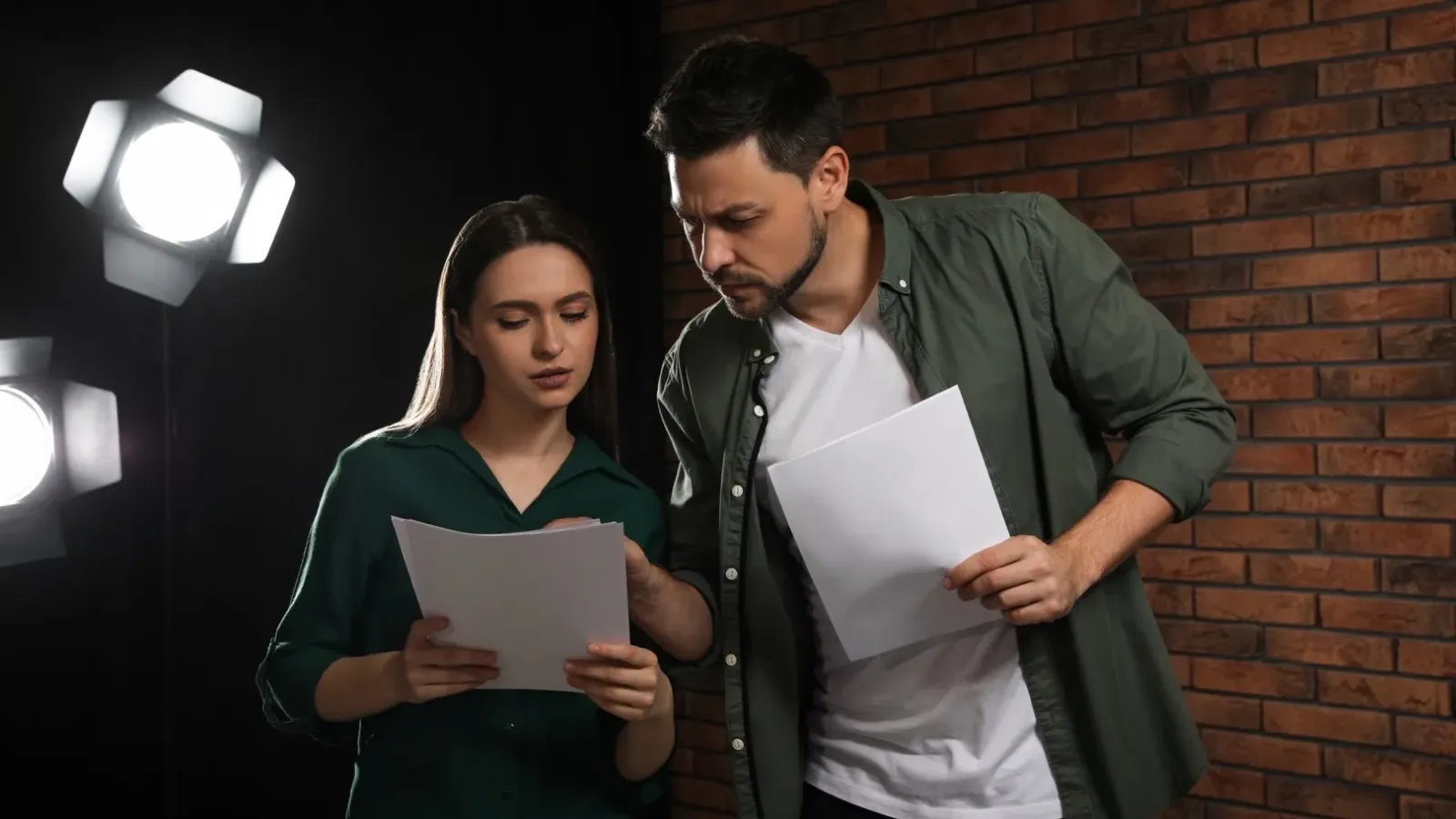
Every actor eventually asks some version of this: if I only have time and money for one thing, do I pour it into a killer showreel or into provable training? It's the wrong question — but it points at a real one. A reel and a verified credential prove different things, casting directors use them at different moments, and the actors who get hired tend to understand exactly what each does. Let's be honest about both.
What a showreel actually proves
Your reel is the only place a casting director sees you act. No credential replaces that. It shows your instrument in motion — your face, your timing, your presence on camera, the specific roles you read as believable. A good reel answers the question casting cares about most at first glance: where do I slot this person?
That instinct is brutally fast. Acting coach Amy Lyndon, quoted by Casting Networks on how to build an acting reel, tells actors to make their type unmistakable — "you know exactly where you're going to put me by the look of my package" — and to put real material on it: "Give me a crying scene. Let me see whether or not you're funny." And it has to land immediately. A guide from IPM Acting Academy advises that a showreel run "between one and three minutes long," warning that "if the first 10 seconds don't engage the viewer, they may not watch the rest."
So the reel's job is clear: prove you can do the thing, on camera, in a way that reads instantly. Nothing else does that.
The showreel's blind spots
But a reel has gaps, and they're worth naming honestly:
- It's curated to the second. It shows your best three takes ever, possibly from years apart. It can't tell a casting director whether you're reliable across a range or just got lucky in one short.
- It can't prove a discrete skill. "Can this actor genuinely fence, ride, do a Glaswegian accent, or sing in tune?" A 20-second clip suggests it; it doesn't confirm it under any standard.
- Newer actors don't have one. If your best footage is a student film, the reel under-sells you — and there's no neutral signal to fill the gap.
- It's unverified by design. Editing, dubbing, and tight cutting are part of the craft, but they also mean a reel is a constructed artefact, not an independent assessment.
What a verified certification actually proves
A credential does the opposite job. It can't show your presence on camera, but it can confirm a specific, assessed capability in a way a stranger can trust — precisely because someone qualified judged it against a published standard and anyone can check it.
This already exists in the actor's world. The British Academy of Dramatic Combat issues stage-combat qualifications "recognised by Equity, Spotlight, and internationally throughout the industry," with a Standard level that signals the training expected of a professional. It sits inside a whole ecosystem of stage-combat bodies that run graded exams across multiple weapons and cross-recognise each other's certifications — built so that "I can do stage combat" becomes "I passed a named exam you can verify," not a hopeful CV line.
Why does that matter to casting? Because credentials are searchable and trustable in a way reels aren't. On a profile, skills function as filters. Casting director Danielle Tarento, in Spotlight's guide to building the perfect profile, urges actors to "list everything you can do — you never know, I may enter a search for a trumpet-playing mezzo soprano," and notes that "good training creates good graduates, so it's an important piece of information." The catch: when those skills are merely self-claimed, the director still has to take a chance. A verified skill removes the gamble.
The certification's blind spots
Certifications have limits too, and pretending otherwise helps no one:
- It doesn't show chemistry, presence, or screen quality. A credential says you can; the reel shows how you make a director feel.
- Not every skill is certifiable. "Magnetic in a close-up" isn't an exam.
- Quality varies wildly. A credential is only as good as who issued it and whether it's checkable — which is the whole subject of our piece on what a trustworthy certification actually looks like.
When casting cares about which
The honest answer is it depends on the stage of the decision — and they're sequential, not competing.
- The first cut is visual and instant. As Spotlight's casting director bluntly puts it, "the first cut we'll make is whether you look right." This is headshot-and-type territory, and the volume is staggering. An anthropologist who studies casting describes a director facing 7,000 submissions for a single small role, where each headshot gets "a quick glance and an instinctual response". Nothing on your CV saves you here; your look and reel do.
- The shortlist is where proof matters. Once you're in the maybe pile, the director digs in. Casting platforms let them sort and filter submissions and click through to your résumé, media, and special skills — Actors Access, for instance, lets casting sort by profile completeness and open up credits, photos, and skills. This is exactly where a verified credential turns "claims to ride horses" into "confirmed," and tips a close call your way.
- Skill-specific roles invert the order. If a role requires fluent Welsh, certified stage combat, or trained dance, the verifiable skill can be the thing that gets your reel watched at all.
The risk angle casting rarely says out loud
There's a quieter reason verified skills move the needle: they lower the casting director's risk, and casting is a risk-management job as much as a creative one. A reel can be edited to imply an ability the actor can't deliver on a live set. A self-listed "fluent French" or "trained in rapier" might be true — or might be a hopeful stretch that surfaces, expensively, on shoot day as a reshoot or a last-minute double. The director carries that downside. So when two actors read equally well on camera, the one whose key skill is confirmed rather than claimed is simply the safer booking. Verification doesn't make you a better actor; it makes you a lower-risk one, and at the shortlist stage that often decides it.
How to use both together
Stop framing it as either/or. Build a profile where the reel and your verified skills cover each other's blind spots.
The actors who win the close calls aren't choosing between showing and proving. They show with the reel and prove with verified skills, so a casting director's gut reaction and their risk assessment both point the same way.
That's the thinking behind Platform Acting: you upload your work for consistent AI feedback across tone, expression, body language, and emotional delivery, a qualified coach validates the assessment and certifies your level, and every certified skill gets a public verification code casting can check in seconds — sitting right alongside your portfolio and self-tapes. If you want the full picture, explore what we built for actors, read about the broader shift toward verifiable credentials in casting, or create a free account and start turning claims into proof.